
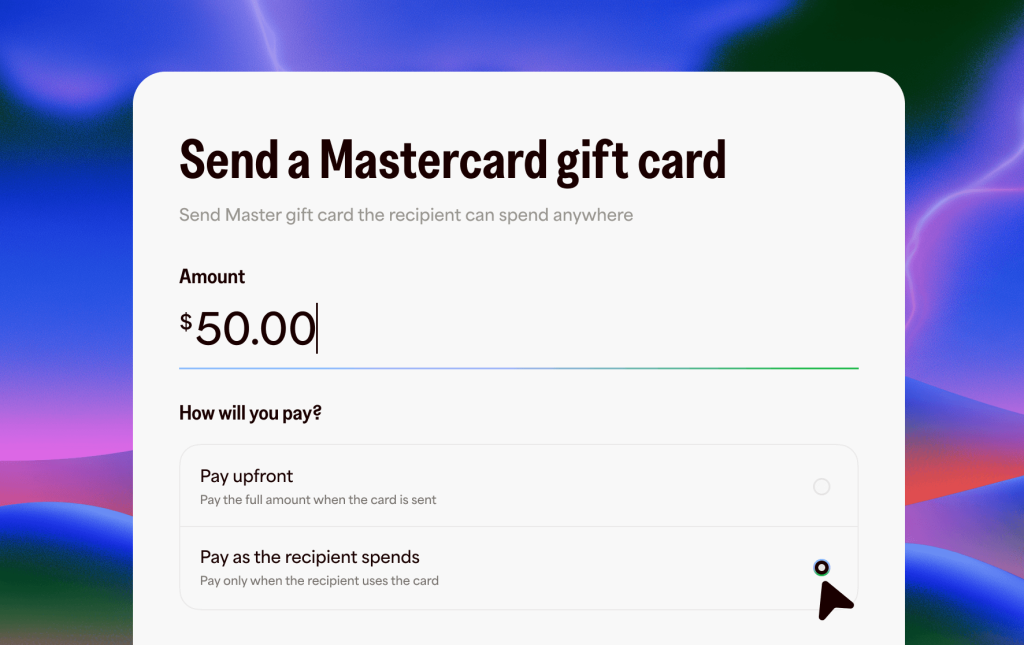
When you send prepaid cards at scale, the money usually leaves your account long before anyone spends it. Real time funding flips that order. Money moves at the moment a card is used, not when it is issued. The model is also known as just in time (JIT) funding, and until recently it was reserved for companies running their own card programs. Fluz brings it to anyone sending payouts.
- Real time funding moves money when a card is spent, not when it is sent.
- It is also called just in time (JIT) funding, a term coined by the card issuing platform Marqeta.
- JIT funding has historically required building your own card program, with a sponsor bank and months of integration.
- Fluz open loop card clients choose their model: prepay for simplicity, or pay as recipients spend.
- In pay as you spend mode, value that never gets used never leaves your account.
What is real time funding?
In a traditional prepaid program, every card carries a balance. You load the full face value upfront, and the money sits on the card until the recipient spends it or the card expires. You are responsible for keeping every balance funded and reconciled.
Real time funding works differently. Cards hold no balance at all. When a recipient swipes, the transaction is authorized and money moves from your funding source in the same instant. The card is funded for exactly the amount of the purchase, exactly when the purchase happens.
The card issuing platform Marqeta pioneered this model and coined the industry term for it: just in time funding, or JIT. It is one of the reasons companies like Block and DoorDash built card programs on modern issuing infrastructure instead of legacy prepaid rails.
Why funding timing matters
Where your money sits between issuance and spend sounds like an accounting detail. At volume, it is the whole ballgame.
- Idle cash stops piling up. Face value that would sit on unspent cards stays in your account, earning yield or funding operations.
- Unspent value is never your loss. Cards that go unused never trigger a charge, so redemption rates stop eating your budget.
- Reconciliation gets easier. No per-card balances to track, top up, or claw back. Your ledger reflects actual spend.
- Cash flow tracks reality. Outflows follow recipient behavior instead of issuance batches, which makes forecasting honest.
The catch has always been access. JIT funding lives at the issuer processor layer, so getting it meant becoming a program manager: sponsor bank relationships, compliance programs, and an engineering integration measured in months. If you just wanted to send 10,000 reward cards, none of that was on the table.
The flagship case: bulk payout cards

This is where real time funding stops being infrastructure trivia and starts being money.
Every major bulk card provider requires prepayment. Platforms like Tremendous ask you to fund your account balance before a single card goes out. Send 10,000 cards at $50 face value and you wire $500,000 on day one, regardless of when, or whether, recipients ever spend it.
Fluz open loop cards give you both models and let you pick per program:
- Prepay works the way you expect. Load your balance, issue cards, done. Some teams prefer the budgeting clarity of paying once.
- Pay as recipients spend is real time funding. Issue all 10,000 cards today, and money moves from your funding source only as swipes happen.
Run the numbers on that second model. At a typical 70% redemption rate, $150,000 of that $500,000 program never leaves your account at all. The remaining $350,000 flows out gradually as recipients actually spend, instead of departing in one wire before anyone has activated a card.
Recipients notice no difference. Cards activate with a phone number, load into Apple or Google Wallet in a few taps, and work anywhere Mastercard is accepted. The change is entirely on your side of the ledger.
Where else real time funding applies
Payouts are the flagship, but the model runs underneath the Fluz platform.
Card programs built on the Fluz API. Platform clients issuing cards inside their own products inherit real time funding, so their card programs launch with JIT economics and none of the program management overhead.
Business spend. Cards that draw on a linked funding source at authorization mean no held balances to maintain and no float sitting apart from your treasury.
See real time funding in action
If your payout program currently starts with a large wire and a redemption report you would rather not read, the fix is a funding model, not a bigger budget. Talk to an expert or launch the demo to see how open loop cards work with real time funding turned on.